

Key Takeaways
Key change: Introduction of low-value goods levy, effective 1 April 2026.
What remains: NZD $1,000 remains as a threshold to determine if a consignment is high or low value, its applicable goods clearance fees, and whether informal/simplified clearance is applicable.
Who should review: Businesses importing into or exporting from New Zealand, including e-commerce and high-volume shippers
Background
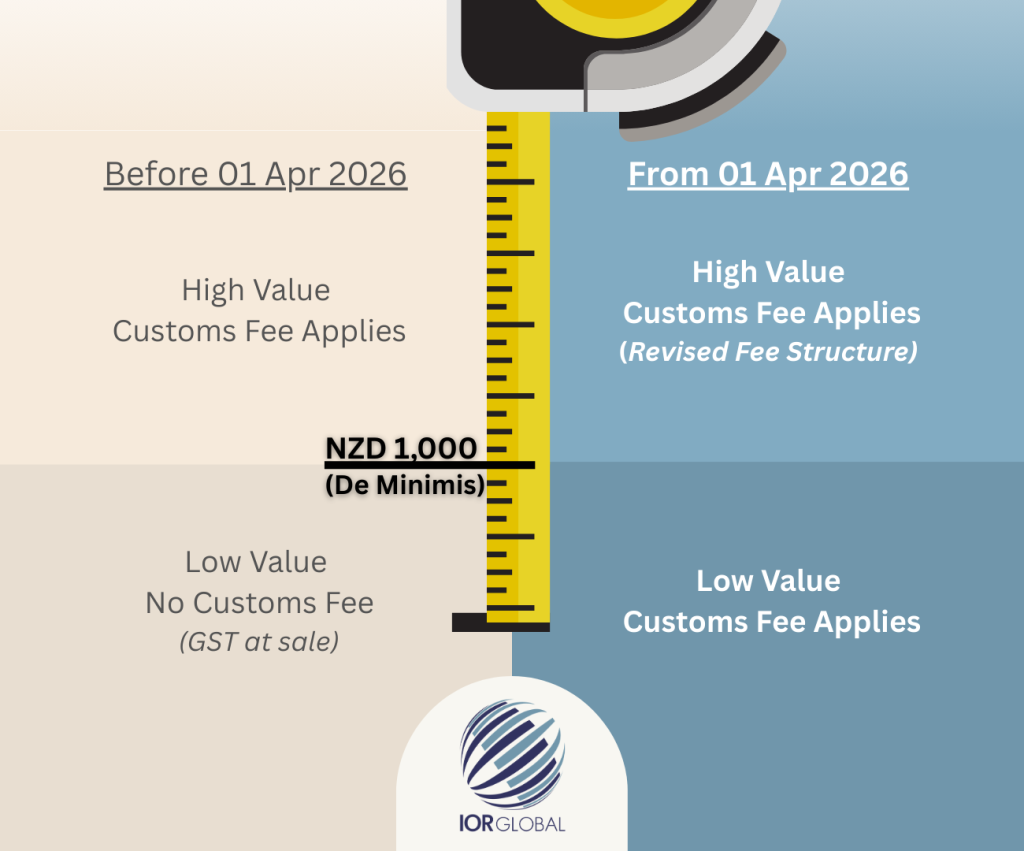
Under current rules, consignments valued at NZD $1,000 or less (typically known as “low value” consignments under the de minimis threshold) are generally not subject to any Customs and MPI fees.
From 1 April 2026, New Zealand Customs and Ministry for Primary Industries (MPI) will introduce a low-value goods levy on all low value goods crossing the border. The NZD 1,000 threshold will remain for classification and clearance purposes; however, it will no longer provide an exemption from Customs and MPI cost recovery charges. This change ensures that the work performed by Customs and MPI can be recovered more fairly from those who benefit from border processing services or whose activities create the need for those services.
NZD $1,000 will remain as the determinant on whether a consignment is considered low or high value. Consignments valued at NZD $1,000 or less can still be customs cleared using an Inward Cargo Report (ICR) or Simplified Import Declaration (SID).
This represents a structural shift in how low-value shipments are treated at the border and may have cost and operational implications for businesses with frequent shipments, high declaration volumes, or e-commerce and distribution models.
What This
Means for
You?
The low-value goods levy introduces new costs for low-value imports that were previously not subject to Customs/MPI charges.
Early review is particularly important for:
- Businesses operating in E-commerce or direct-to-consumer fulfillment models
- Businesses that have high-frequency, low-value shipment flows that rely on the NZD $1,000 threshold to manage landed costs
These per-shipment fees may result in a material cumulative cost impact over time, even where individual charges appear modest in isolation. See revised framework below.
How Can We Help?
While the Customs/MPI charges are unavoidable, such changes highlight the importance of having a compliant and resilient import structure.
IOR Global acts as Importer of Record (IOR) and Exporter of Record (EOR) for businesses operating internationally. With established compliance frameworks across 120+ countries, including New Zealand, we manage Customs and regulatory obligations on your behalf, reducing operational risk and administrative complexity.
If your business conduct imports into or exports from New Zealand, let’s discuss how we can support your trade operations in 2026 to ensure continued compliance and efficiency.
Customs Fees & De Minimis Treatment: Before vs After
The tables below summarise the current framework and the new fee structure effective 1 April 2026.
Current Framework (Before 1 April 2026)
Current Customs Fees and De Minimis Treatment
All fees shown exclude GST
| De minimis threshold | Fee Type | Mode | Fees (NZ$) |
|---|---|---|---|
| Goods valued ≤ NZ$1,000 | No Customs payment required (GST collected at point of sale) | ||
| Goods valued > NZ$1,000 | Subject to 15% GST, duty (if applicable), and | ||
| Import Entry Transaction Fee | Both | 46.47 | |
| Biosecurity System Entry Levy | Both | 46.40 | |
| Inward Cargo Transaction Fee | Air | 104.36 | |
| Inward Cargo Transaction Fee | Sea | 207.53 | |
Under the current framework, low-value consignments (≤ NZ$1,000)generallybenefit due to the exclusion from any applicable Customs/MPI fees.
New Framework (Effective from 1 April 2026)
New Customs & MPI Fees (Selected Import-Relevant Charges)
All fees shown exclude GST
| Consignment Type | Mode | Customs (NZ$) | MPI (NZ$) | Combined (NZ$) |
| High-value import (> NZ$1,000) (usually paid by customs brokers) | Air | 7.24 | 44.57 | 51.81 |
| High-value import (> NZ$1,000) (usually paid by customs brokers) | Sea | 73.87 | 44.57 | 118.44 |
| Low-value import (≤ NZ$1,000) (usually paid by freight forwarders) | Air | 1.46 | 0.75 | 2.21 |
| Low-value import (≤ NZ$1,000) (usually paid by freight forwarders) | Sea | 1.34 | 0.75 | 2.09 |
| Inward international mail (usually paid by craft operators) | Per kg | 0.40 | 0.88 | 1.28 |
| International transshipment (usually paid by freight forwarders) | Air | 1.46 | Nil | 1.46 |
| International transshipment (usually paid by freight forwarders) | Sea | 1.34 | Nil | 1.34 |
| Empty container (usually paid by shipping lines) | Sea | 1.34 | Nil | 1.34 |
| High-value export (usually paid by customs brokers) | Air | 3.35 | Nil | 3.35 |
| Secure export scheme (usually paid by customs brokers) | Sea | 3.76 | Nil | 3.76 |
| Other high-value export (usually paid by customs brokers) | Sea | 8.13 | Nil | 8.13 |
| Low-value export (usually paid by freight forwarders) | Air | 2.48 | Nil | 2.48 |
| Low-value export (usually paid by freight forwarders) | Sea | 3.22 | Nil | 3.22 |